
How do you store, thaw, and reheat breast milk?
Breast milk is special: it's living food. It contains not only fats, carbohydrates, and proteins, but also antibodies, enzymes, and living cells that protect your baby. These precious nutrients are sensitive to heat, light, and time. That's why it's important to store, freeze, thaw, and reheat expressed milk correctly to preserve its quality and ensure your baby gets the best every time.
SHORT READ
Subject | Short guideline |
What to store in? | Breast milk bags: space-saving, but pour over after thawing and often not in the warmer. Plastic bottles (BPA-free): directly in the warmer, take up more freezer space. Glass bottles: easy to keep clean, directly in the warmer, but fragile. |
Labels | Always note the date and time (day/night milk if necessary) before filling. |
How to fill? | Bottles/jars: up to ¾ full Bags: 150–180 ml max or below the filling line Always leave 1–2 cm space and squeeze out air |
Freeze portions | Preferably 60–120 ml per portion (for newborns also 30–60 ml) |
Room temperature (16–25 °C) | Fresh milk: 6–8 hours Colostrum: up to 12 hours |
Refrigerator (0–4 °C) | Up to 8 days : store at the back/bottom , not in the door |
Freezer | Freezer compartment refrigerator (≈ −6 °C): up to 2 weeks Small freezer (≈ −12 °C): up to 4 months Deep freezer −18 °C or colder: safe for up to 12 months, preferably use within 6 months |
Merge milk | Only combine milk of the same temperature . Cool fresh milk before adding it to frozen milk. |
Defrost | Preferably slowly in the refrigerator (12–24 hours) Or under lukewarm running water No microwave, no hot water |
After thawing | Use within 24 hours (stored in refrigerator). Do not refreeze. |
Warm up | In a bain-marie or milk warmer on low setting . Until lukewarm (~37 °C) . Do not shake, but swirl gently. |
Why not too hot? | High temperatures break down protective substances and can cause hot spots |
Leftovers after feeding | Baby has drunk from it: use within 1–2 hours, then discard. Not yet drunk: use within 2 hours (may be reheated once during this time). Do not refreeze or refreeze. |
Recognizing spoiled milk | Discard if there is a sour/rancid odor, a foul taste, or a gritty texture that doesn't mix. |
Soapy smell? | Often lipase, not spoiled . Sometimes babies refuse it. Scalding can stop lipase (only if necessary). |
Important to remember | Clean working Always note the date Never refreeze thawed milk Preferably small portions → less leftovers |
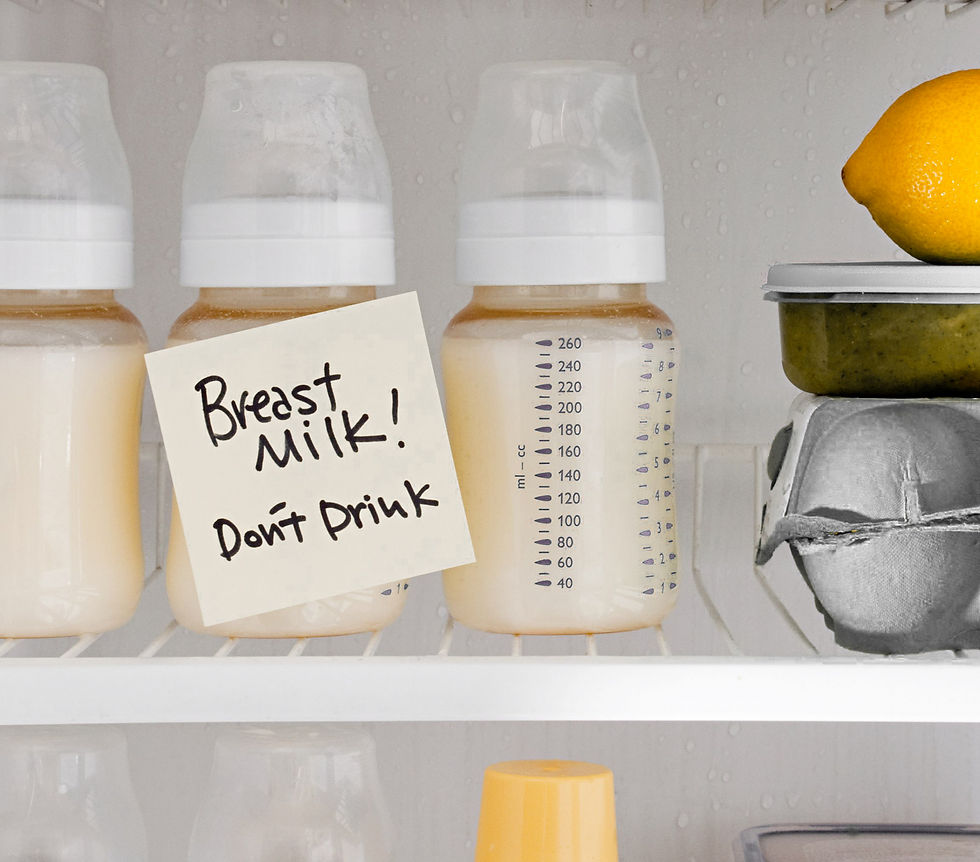
Where do you store breast milk?
First of all: think about where you are going to store your breast milk.
That really makes a difference to the quality.
Preferably choose:
Sturdy, special breast milk bags : You can freeze these flat, which is super convenient because they take up very little space in your freezer. Note: after thawing, you'll need to pour the milk into a bottle, and most bags aren't suitable for use in a milk warmer.
Well-sealed hard plastic bottles : Big advantage: you can simply place them in the milk warmer. Less convenient: they take up more space in the freezer. And heating plastic can release toxins. So always choose BPA-free.
Well-sealed glass bottles : These are sturdy, easy to clean, and can be placed in a milk warmer without the risk of plastic contaminants. They are more fragile, however, and take up more space in the freezer.
Regular freezer bags? They leak more easily, so preferably not.
Which one you choose depends mainly on what you find practical: saving space → less transferring of bags → bottles or glass
Smart labeling
Always write the date and time on the pump bag before filling and freezing it.
This is the easiest way to write it down and later you will know exactly how old the milk is and which portions you should use first.
Some parents also like to note whether it is day or night milk (for example with a sun or moon).
Breast milk changes with the daily rhythm : morning milk generally contains slightly more "wake-up" substances like cortisol, while evening and nighttime milk contains more melatonin. In theory, it can help to feed your baby around the same time as the pumped milk, but the evidence that this makes a real difference in practice is still limited. So, consider it a pleasant bonus, not a requirement.
You can fill it this full
Because breast milk expands during freezing , fill in:
Bottles or jars: up to approximately ¾ full
Breast milk bags: maximum 150–180 ml per bag, or fill them to just below the fill line if indicated
Rule of thumb: always leave at least 1–2 cm of space at the top.
Always squeeze as much air as possible out of breast milk bags before closing them.
Freeze quantities at a time
It's helpful to freeze breast milk in 60–120 ml portions. This is roughly an average feeding, so you won't have to throw away leftovers as often.
It's better to freeze several small 60 ml portions than one large one. You can always thaw two portions, but once thawed, you can't refreeze.
How long can you store breast milk?
Room temperature (16–25 °C)
Fresh breast milk: 6–8 hours
Colostrum: up to 12 hours
Breast milk contains substances that inhibit bacterial growth. If you don't expect to use the milk within a few hours, it's best to refrigerate it.
Refrigerator (0–4 °C)
Fresh breast milk: up to 8 days
Store the milk at the back and bottom of the refrigerator. Don't put it near the door, as the temperature fluctuates there. You can combine milk of similar temperatures. The date of the oldest milk counts towards the entire batch.
Tip: Going out, going to work, or want to keep expressed milk cool overnight without having to constantly run to the refrigerator? Then you can use a special bottle or milk cooler .
This is ideal if you want to keep your milk cold for a longer period of time, or if you simply want to leave the bottle on your bedside table after pumping. Place a milk warmer next to it, and you won't even have to get out of bed.

Freezing breast milk
How long you can store breast milk in the freezer depends on the type of freezer. As a rule, the colder and more stable the temperature, the better the quality is preserved.
Freezer compartment in refrigerator (approximately −6 °C): can be kept for up to 2 weeks.
Small freezer/table model (approximately −12 °C, opened and closed frequently): shelf life up to 4 months.
Large freezer with separate door (-18°C or colder): safe for up to 12 months but preferably use within 6 months.
If you plan to breastfeed for a longer period and have the space, a separate freezer might be worthwhile. It's convenient that you can easily access the oldest bags, so a freezer with drawers or compartments often works better than a chest freezer, as you won't have to dig as much to get to the first frozen milk.
First cool the fresh milk in the refrigerator and preferably freeze it within 4 days
Don't add fresh, warm milk to fully frozen milk . The temperature difference can reduce the quality and cause (partial) thawing. If you still want to combine the milk, cool it completely in the refrigerator first , so both milks are equally cold before freezing them together.
Thawing breast milk
When thawing, always choose the bottles or bags with the oldest date first, as long as they are still within their shelf life. If the milk has been stored longer than recommended, it's best to discard it. Frozen milk can deteriorate and is therefore less safe for your baby.
Safe Ways to Defrost

Slowly in the refrigerator (recommended): Place the milk in the refrigerator for 12–24 hours until it
is completely thawed.
Thaw faster: Hold the bottle or bag under lukewarm (not hot!) running water and move it gently back and forth.
Using a milk warmer: This is only permitted if the milk is already (partially) thawed or has come straight from the refrigerator. Use a low or standard setting and avoid high temperatures.
In a bain-marie (in a bowl of warm water): Place the bottle in a bowl or pan of lukewarm water. Do not boil or use boiling water.
It is best to use thawed milk within 24 hours (stored in the refrigerator).
How to warm breast milk safely
First of all, only heat up the food just before feeding. Place the bottle or jar of (thawed or refrigerator-cold) milk in a bowl or container of warm water. This is called a bain-marie. You can also use a milk warmer on a low/standard setting. Let the milk warm gently, swirling the bottle occasionally to mix the fat layer. Do not shake.
How warm should it get?
Start at hand-warm/body temperature (approximately 37°C). Test a drop on your wrist. It should feel neutral/warm, but not hot.
It is best not to make breast milk too hot.
At high temperatures, protective substances such as antibodies, enzymes, and living cells—the very "magical" components that help protect your baby from infection—are broken down. The composition of the milk can also change, as fats and proteins are damaged by heat. Furthermore, if milk is heated unevenly, especially in the microwave, hot spots can develop that can burn your baby. And sometimes the flavor changes, making babies less likely to drink it.
Therefore, always warm your breast milk gently until it is lukewarm (approximately body temperature) and not warmer.
Leftovers after a feeding
Milk that has already been warmed up and from which your baby has drunk
Use within 1–2 hours . Then discard.
As soon as your baby drinks from the bottle, bacteria are introduced into the milk. These bacteria multiply faster in warm milk, so don't save leftovers for later or reheat them.
Milk that has been heated but not yet drunk
Use within 2 hours of heating. You may reheat the milk one more time during this time. Then discard.
Do not refreeze or refreeze.
Important to remember
Never refreeze thawed milk
Preferably do not reheat multiple times
Always warm breast milk gently to lukewarm, not hot
How do you recognize spoiled milk?
Normal breast milk can vary in appearance: for example, there might be a layer of fat floating on top that mixes nicely when you gently swirl the bottle, and the color can range from yellow or cream to light blue or even a little greenish. This is all normal.
But just like regular milk, breast milk can also spoil. Fortunately, this is usually easy to recognize:
smells sour or rancid
tastes distinctly unpleasant
remains grainy and crumbly (even after you gently stir it)
If you see or smell this, throw the milk away.
But beware: “soapy” smell ≠ spoiled
Sometimes breast milk smells sharp or slightly soapy after cooling or freezing. This is due to the enzyme lipase, which breaks down fats. This is not a spoilage, and the milk is perfectly safe to feed.
So the milk is good, but some babies dislike the taste and refuse the bottle. If this happens, you might consider briefly pasteurizing (scalding) the milk after pumping to stop the lipase from working, and then freezing it.
Breast milk is full of antibodies and therefore often has a longer shelf life than many people think.
However, official guidelines are sometimes cautious, as relatively little research has been conducted on daily use in home settings. Therefore, storage times have been deliberately kept well to the safe side.
Breast milk is robust and precious, even after cooling or freezing, it remains a wonderful food. With clean materials, good labels, and the correct temperatures, you can go a long way. And remember: these are guidelines, not stress-inducing rules.
If something accidentally goes off-limits, use your senses: look, smell, and even taste a drop. If you're unsure about the smell or quality, it's best to throw the milk away. Safety first.
Love,
Bobby


