
Manual pumping: the instructions.
Updated: 6 hours ago

Hand expressing is a skill that can be helpful for some parents, both before and after birth. Perhaps you are considering practising before birth. Or you have just given birth and want to know how to collect colostrum or breast milk by hand. In both situations, a calm, good technique makes a big difference.
In a previous article I discussed prenatal hand expressing in detail. There you can read when it is appropriate and when it is not, and what the possible advantages and disadvantages are. I also explain why common myths are untrue, such as the idea that hand expressing speeds up labour.
The basic technique is the same, but the approach differs in some areas. Where this is the case, I'll clearly indicate it. This way, you can follow the instructions in a way that suits your specific moment, your body, and your situation.
Contents
When to manually express breast milk?
Prenatal (before birth)
Usually from 36 to 37 weeks of pregnancy, in consultation with your midwife
Maximum 1 to 2 times per day
About 5 to 10 minutes per breast
The goal is to introduce hand expressing gradually, without expectations about how much will or will not come out.
Not intended to build stock or increase milk production
Postnatal (after birth)
Hand expressing can be started immediately after birth
Often more often per day, depending on the situation
The purpose may be to collect colostrum, supplement, stimulate milk production or relieve full or engorged breasts.
Not sure if hand expressing is right for you? Talk to your midwife, lactation consultant or doctor. An earlier blog about prenatal hand expressing explains when it is and is not appropriate.
What do you need?
You don't need much, but good preparation helps.

Colostrum collectors or syringes
Suitable for collecting small amounts of colostrum. Personally, I find a syringe more practical in most cases.
Heat
For example, a hot shower or a wheat bag
A wheat bag is comfortable because of its shape, easy to place around the breast, and also helpful postnatally for afterpains. It can also be used to preheat your baby's bed or to help with colic.
Time and rest
This is not a rush moment.
A comfortable place to sit
Preferably with good support, leaning slightly forward.
A towel
For any leakage.
Clean hands
Step 1: The environment
Make sure you're in a quiet, warm environment where you won't be disturbed. Warm your breasts for a few minutes with a wheat bag or take a warm shower. Heat promotes blood circulation and can help your milk flow.
Sit slightly leaned forward so that gravity can help collect the milk.
Step 2: Breast massage
Before you start hand expressing, massage your breast briefly to relax it.

Start by briefly massaging your breast to relax it. Place your hands around your breast, as if gently holding it. Make small, gentle circular motions with your palms, starting high on your breast and working your way toward your nipple. Move your hands around your breast and repeat these circles, covering all sides.

Then, gently move your hands back and forth on either side of the breast, as if you were rocking it.
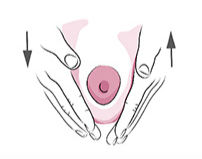
Finish with stroking movements. Use your fingers or the backs of your fingers. Stroke slowly from the outside of the breast towards the nipple, as if gently guiding the milk forward. You can do this around the entire breast.
The massage lasts about a minute per breast, longer if it feels comfortable. The most important thing is to keep it gentle and relaxing. There's no need to squeeze or push.
Step 3: The hand expressing technique
Step | Front view | Side view |
Hand position: Place your thumb above and your fingers below your breast, about 2 to 3 cm from where the nipple meets the breast. Your hand forms a C-shape. If your areola is large, place your hand a little further out. |  |  |
Press: First, gently press your hand back toward your chest. | |  |
Pinch: Then, lightly squeeze your thumb and fingers together and roll them forward, toward the nipple. Then release and relax your hand. Repeat the movement gently: press, squeeze, roll, release. Do not let your fingers slide over the skin. |  |  |
It shouldn't hurt. If you pull on the nipple or pinch the areola, you're too far forward.
After a few repetitions, move your hand around the breast (above, below, and to the sides) to stimulate different milk ducts. A few drops or sheen is normal.
Are you unsure whether you are performing the movement correctly? The video below shows what hand expressing looks like in practice.
Step 4: Collecting colostrum or milk
You express with one hand and use the other to collect the colostrum. Colostrum is often thick, yellow and sticky, and usually comes in small amounts.
It may take a few sessions before you see anything, and sometimes it doesn't happen at all. If nothing comes out, that's fine and completely normal. Stay calm and give yourself and your breasts time. If something does come out, you can collect it with a syringe or a colostrum collector.
This is what it looks like


When using a syringe, pull out the plunger and collect the drops directly in the syringe. The following video demonstrates this clearly.
How much is normal?
Prenatal hand expressing usually involves a few drops to about 1 ml per session. Sometimes, none at all. This is normal and says nothing about your milk production after birth.
With postnatal hand expressing, in the first few days after birth, the output varies greatly. It differs from person to person and from moment to moment. Initially, your body produces colostrum, often in small amounts. It is perfectly normal to express a few drops to millilitres per session, especially in the first 24 to 48 hours. As the days progress and milk production begins, the amount gradually increases.
Both prenatally and postnatally, hand expressing is not about large quantities, but about attunement and the process itself.
Storing colostrum (syringes and collectors)
Because hand expressing often involves small amounts of colostrum, careful storage is important. This ensures the milk remains safe and is ready for use later.
Immediately after expressing
Immediately close the syringe or colostrum collector tightly. Write the following on each syringe or collector:
the date of expressing
if necessary, the time (useful if you take multiple samples on one day)
Washing your hands
Freeze
Colostrum can be safely frozen.
Place syringes or collectors in the freezer as soon as possible
Preferably store them at the back of the freezer
Lay them flat or upright, depending on what is practical
Storage times according to the Dutch Nutrition Centre (Voedingscentrum):
at room temperature: 4 hours
in the fridge at 4 °C: 3 days
in the freezer at -18 to -20 °C: 6 months
in the freezer compartment of a normal fridge: 2 weeks
Giving birth in hospital? Take the frozen colostrum with you in a cool bag with a cooling element and hand it to the nursing staff.
A separate blog explains step by step how to store, freeze and thaw breast milk safely.
Defrost
Defrosting is best done slowly:
Place the syringe or collector in the refrigerator. Because of the small quantities, it often thaws quickly.
You can then bring it to body temperature by holding the syringe or collector in a bowl of lukewarm water.
Do not use a microwave and do not heat milk directly on the stove.
After defrosting
Use thawed colostrum as soon as possible
Do not refreeze milk once it has thawed
Store thawed colostrum in the refrigerator for a maximum of 24 hours
Throw away leftovers that have been reheated and not used
How do you give collected colostrum?
Because colostrum is often in very small quantities, it is usually not practical to give it in a bottle. There are several gentle ways to give colostrum to your baby, tailored to what feels right at that moment.
With a syringe or collector
A syringe can help to administer small amounts slowly.
Hold your baby relaxed and awake, preferably upright or semi-upright. Gently place the spout in the corner of the mouth, along the inside of the cheek. Let the colostrum flow in slowly. Take your time and follow your baby's pace.
With a teaspoon
You can also give colostrum with a clean teaspoon. Place a few drops on the spoon and let your baby lap it up gently. This can be helpful for very small amounts and for alert babies.
Directly from the breast
Sometimes it helps to put a few drops of colostrum on the nipple, just before you latch your baby. This can encourage your baby to nurse without you having to force anything.
It doesn't help to squirt colostrum into the mouth all at once or insert a feeding device deep into the mouth. It's more comfortable to offer it slowly, in small amounts, at your baby's pace.
Frequently asked questions
When can you start hand expressing?
Before birth, parents usually start from 36 to 37 weeks of pregnancy, in consultation with the midwife. Not sure whether it suits your situation? Talk to your midwife, lactation consultant or doctor.
How much colostrum is normal with hand expressing?
Before birth it is usually a few drops to about 1 ml per session. Sometimes nothing comes out. After birth the amount varies a lot per person and per moment.
Does hand expressing hurt?
No, hand expressing should not hurt. If you pull on the nipple or pinch the areola, you are too far forward. Move your hand a little further back.
How do you store collected colostrum?
Close the syringe or collector tightly and write the date on it. It keeps for 4 hours at room temperature and 3 days in the fridge. In a freezer at -18 to -20 degrees it keeps for 6 months.
How do you give a few drops of colostrum to your baby?
With a syringe, a clean teaspoon or straight onto the nipple just before you latch your baby. Give it calmly, into the corner of the mouth. Squirting it all in at once does not help.
Can colostrum go back into the freezer after thawing?
No. Use thawed colostrum as soon as possible and keep it in the fridge for 24 hours at most. Thaw it slowly, and never in the microwave.
For some, hand expressing is a nice, calm way to prepare for the arrival of a baby. For others it can feel like extra pressure or a moment of achievement.
And that difference is allowed. Every pregnancy, birth and start is different. For some women, not enough colostrum is released (yet) for the baby's needs. It is then supplemented with formula. This is normal and okay. Some women find it reassuring to give their body that space and (temporarily) supplement with formula. Others prefer to use hand expressing or expressed breast milk as much as possible. There is no route that is right for everyone.
Ultimately, it's all about balance: between rest, recovery, and a well-fed baby. What helps is having the space to follow what's needed at that moment. For your baby and for you as a mother.
Love,
Bobby
Sources
Written by Bobby, maternity nurse at Bobby Kraamzorg. Last updated: September 2026.
Bobby believes in being transparent. Some links in this article are affiliate links. This information is free and stays free, for everyone. Bobby only recommends products she would recommend without a fee, and works with no sponsors. If you order through such a link, a small commission goes to Bobby. It is a way to support her, if you want to.


